
.png)
%20(5).png)
%20website%20header.png) REQUEST DEMO
REQUEST DEMO
.png)


Patient expectations shaped by platforms like Uber are redefining healthcare revenue cycle performance. Workflow fragmentation impacts patient experience, cash flow, and efficiency, while Jorie AI drives automation, transparency, and faster financial outcomes.
Patients now expect the same level of clarity, speed, and convenience they experience in every other part of their lives. Digital platforms have trained consumers to expect real time updates, simple transactions, and full visibility into outcomes.
Healthcare organizations are now being evaluated through that same lens, especially when it comes to financial experience.
For executives, this shift is already impacting performance across key metrics including patient satisfaction, cost to collect, and revenue cycle efficiency.
The revenue cycle has become one of the most important drivers of overall patient perception.
The financial journey is one of the most frequent and emotionally sensitive touchpoints patients have with a healthcare organization.
Every interaction carries weight:
When these processes break down, patients experience confusion, frustration, and delays. Those experiences influence whether they trust the organization, return for future care, or pay in a timely manner.
Operational inefficiencies quickly become experience failures.
Platforms like Uber set a clear standard for how modern experiences should function.
Users receive immediate visibility into:
These elements reduce uncertainty and build confidence.
In contrast, many healthcare revenue cycle processes still rely on disconnected systems, manual work, and delayed communication. Patients often move through the financial journey without clear answers or consistent updates.
That lack of visibility creates friction at every stage of the experience.
For executives, this gap translates into missed revenue opportunities, higher operational costs, and lower patient satisfaction scores.
Most healthcare organizations have invested heavily in core systems such as electronic health records, practice management platforms, and payer connectivity tools.
The challenge sits between those systems.
Revenue cycle workflows often require teams to:
This environment creates delays, increases error rates, and limits scalability.
Teams spend time managing processes instead of improving outcomes.
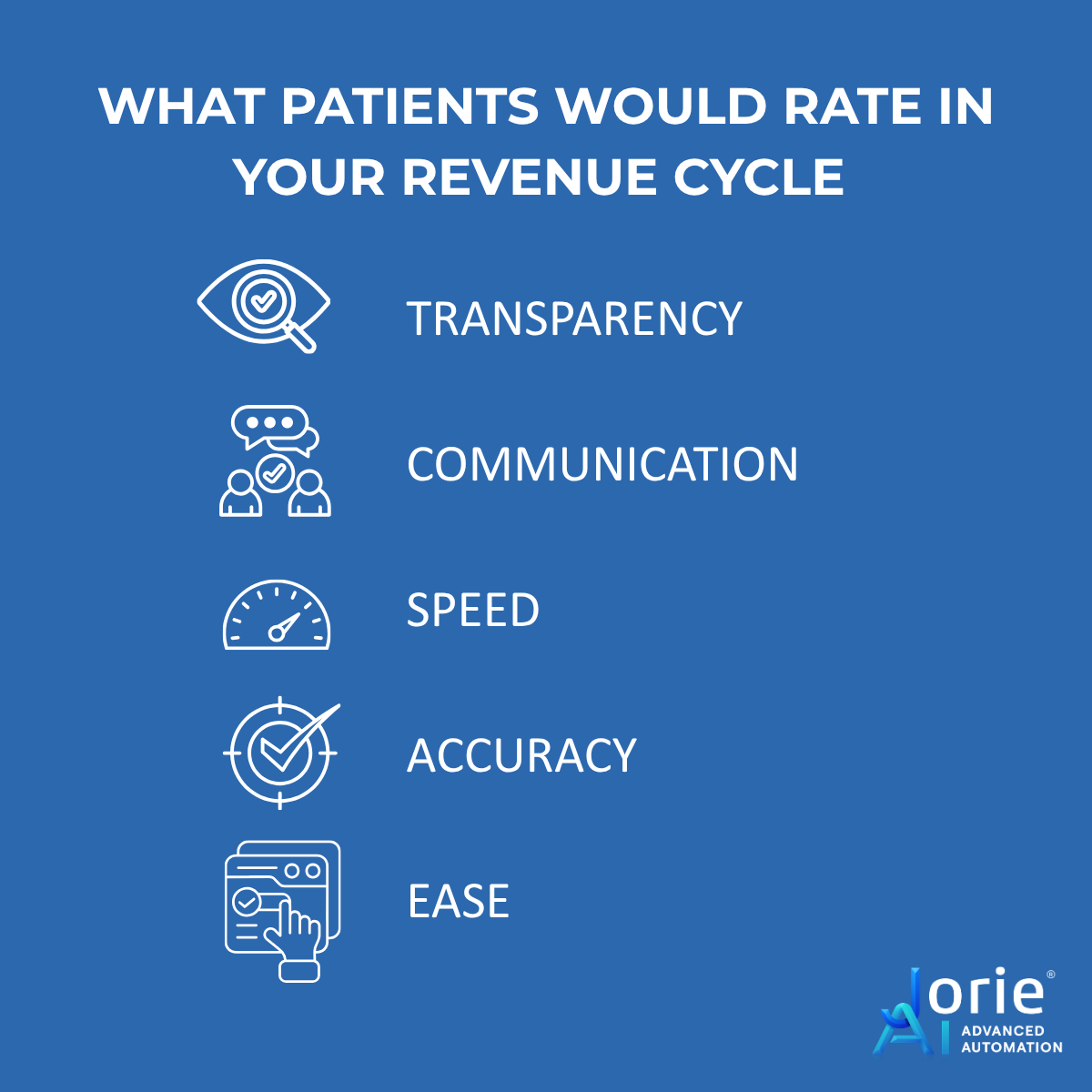
If patients evaluated the financial experience the same way they rate consumer platforms, their feedback would center on five areas:
Transparency Clear understanding of costs before services are delivered
Communication Consistent updates throughout the financial journey
Speed Timely resolution of billing questions and claims
Accuracy Confidence that bills are correct and consistent
Ease Simple, intuitive payment and support processes
Each of these areas directly connects to operational performance inside the revenue cycle.
Revenue cycle inefficiencies create measurable business challenges:
Adding more tools or increasing staffing levels rarely solves the underlying problem.
Disconnected systems continue to create gaps. Manual workflows continue to introduce delays and errors. Teams remain reactive instead of proactive.
Sustainable improvement requires coordination across the entire revenue cycle.
That coordination must happen in real time and at scale.

Jorie AI connects systems, automates workflows, and removes the manual steps that slow down revenue cycle operations.
It acts as an orchestration layer across existing technology investments, allowing organizations to maximize the value of the systems they already have.
Key capabilities include:
Workflow Automation Across the Revenue Cycle Automates eligibility verification, prior authorization tracking, claim status checks, and follow up processes
Real Time Operational Visibility Provides insight into workflow status, bottlenecks, and performance metrics across teams and systems
Data Synchronization Maintains consistency across platforms, reducing errors and eliminating redundant work
Faster Throughput Accelerates task completion and reduces delays across the revenue cycle
Improved Patient Financial Experience Delivers clearer communication, fewer errors, and more predictable outcomes for patients
These improvements strengthen both operational performance and patient trust.
Revenue cycle transformation is no longer a back office initiative. It directly impacts growth, efficiency, and patient loyalty.
Organizations that invest in workflow orchestration and automation gain:
Leaders who take action now position their organizations to meet rising expectations while maintaining control over costs and complexity.
Patient expectations will continue to rise as digital experiences evolve across industries.
Healthcare organizations that deliver clarity, speed, and consistency within the revenue cycle gain a meaningful competitive advantage.
Healthcare leaders have a clear opportunity to improve both financial performance and patient experience through smarter revenue cycle operations.
See how Jorie AI can help your organization reduce inefficiencies, accelerate cash flow, and deliver the transparency patients expect.
Request a demo today and take the next step toward a more connected, high performing revenue cycle.
Follow Jorie AI on Instagram: Instagram
Follow Jorie AI on Tiktok: Tiktok
Follow Jorie AI on LinkedIn: LinkedIn


.jpg)

